A kitchen benchtop needs to do much more than look good. It is one of the hardest-working surfaces in the home, dealing with meal preparation, spills, heat, appliances and everyday wear.
When planning a kitchen renovation, choosing a durable benchtop can help create a space that continues to look and perform well for years. But durability is not the only consideration. Appearance, maintenance, budget, installation requirements and how you use your kitchen should all influence your decision.
For Sydney homeowners comparing options, here are some of the best durable kitchen benchtops to consider for a new or renovated kitchen.
What Makes a Good Kitchen Benchtop?
A good kitchen benchtop should balance durability with practical everyday use and complement the overall kitchen design.
Important factors to consider include:
- Resistance to everyday wear and scratching
- Resistance to stains and moisture
- Heat resistance
- Ease of cleaning
- Ongoing maintenance requirements
- Appearance and available finishes
- Compatibility with sinks, cooktops and cabinetry
- Installation requirements
- Your renovation budget
No benchtop material is completely maintenance-free or indestructible. Understanding the strengths and limitations of each option makes it easier to choose a surface that suits your household.
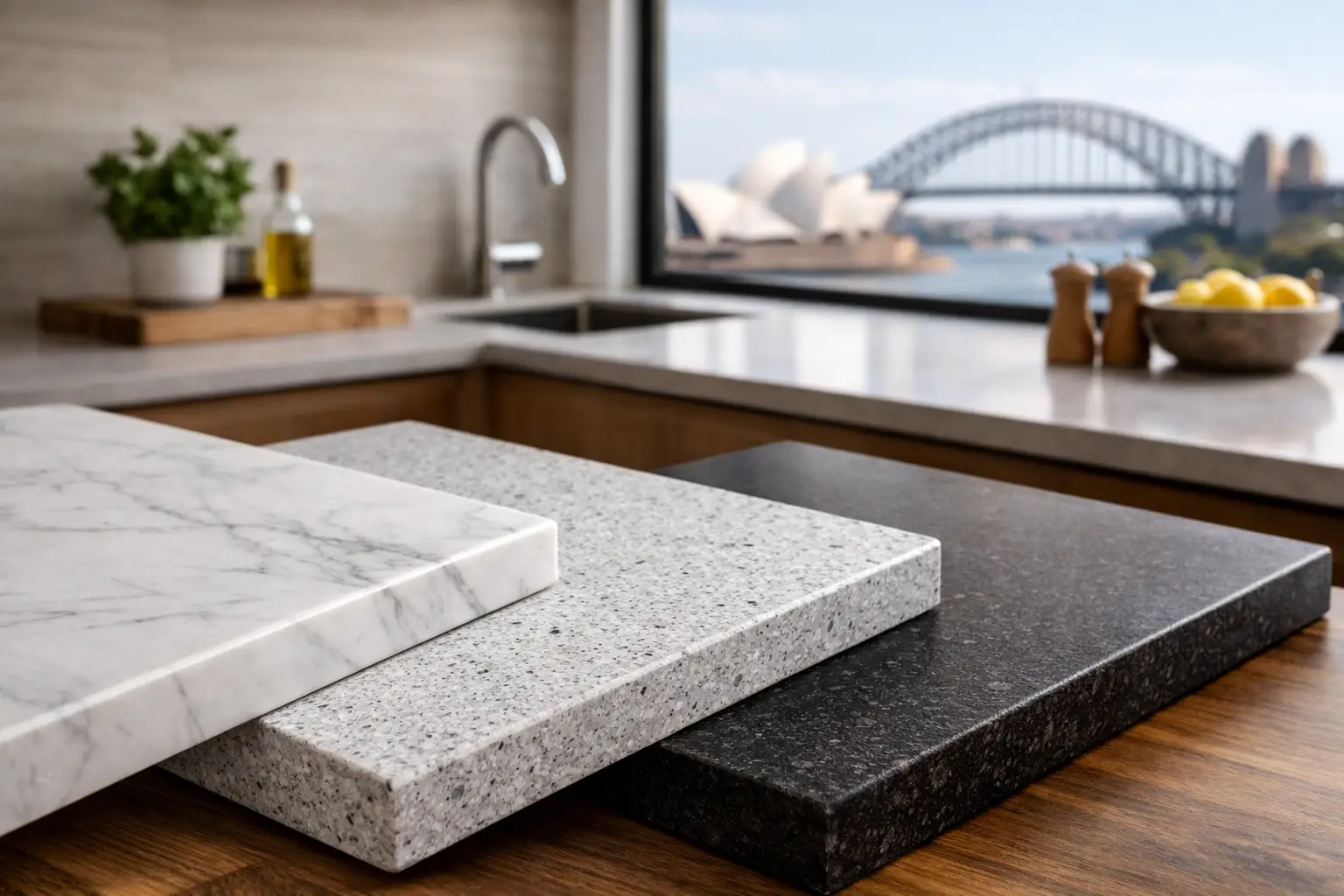
1. Porcelain Benchtops
Porcelain has become an increasingly relevant option for contemporary Australian kitchens. It can provide a refined stone-like appearance while offering strong performance for everyday kitchen use.
Porcelain surfaces are available in a wide range of colours and finishes, including designs inspired by marble, concrete and natural stone.
Why Consider Porcelain?
- Strong resistance to stains
- Good resistance to heat
- Low water absorption
- Easy-to-clean surface
- Available in many contemporary finishes
- Suitable for modern kitchen designs
Porcelain can be a strong choice for homeowners who want a streamlined, modern benchtop with relatively straightforward everyday maintenance.
Like other hard surfaces, however, edges can still be vulnerable to impact, and professional fabrication and installation are important.
2. Sintered Stone Benchtops
Sintered stone is another option worth considering when durability and contemporary styling are priorities.
It is manufactured using mineral-based materials subjected to heat and pressure to create a dense surface. Depending on the particular product, it can offer strong resistance to heat, staining and everyday wear.
Advantages of Sintered Stone
- Durable surface
- Good heat resistance
- Low water absorption
- Wide range of finishes
- Suitable for contemporary kitchens
- Relatively easy everyday cleaning
Product specifications vary between manufacturers, so the characteristics of the particular surface should always be checked before making a final selection.
3. Granite Benchtops
Granite has been used in kitchens for many years and remains a popular natural stone option.
Because granite is quarried rather than manufactured to achieve a completely uniform appearance, every slab has its own variations in colour, pattern and veining. This can give a kitchen a distinctive natural character.
Advantages of Granite
- Strong and durable natural material
- Good heat resistance
- Distinctive natural appearance
- Available in different colours and patterns
- Can suit both contemporary and traditional kitchens
Granite does require appropriate care. Depending on the stone and finish, sealing may be recommended to help reduce staining and moisture absorption.
Homeowners who like natural variation and are comfortable with some ongoing maintenance may find granite an excellent long-term benchtop choice.
4. Other Natural Stone Benchtops
Natural stones such as marble can create a striking kitchen, particularly when visual character and natural veining are important to the design.
However, different natural stones perform differently.
Marble, for example, can be more susceptible to staining, scratching and etching from acidic substances than some harder benchtop options. That does not necessarily make it unsuitable, but homeowners should understand the maintenance and appearance changes that can occur with use.
Natural stone is often best selected by considering the actual slab as well as its technical characteristics.
5. Laminate Benchtops
Laminate remains one of the most accessible kitchen benchtop options and has improved considerably in appearance over the years.
Modern laminate is available in finishes that reproduce the look of timber, stone, concrete and other materials, allowing homeowners to achieve a particular style without the cost of many premium surfaces.
Advantages of Laminate
- Budget-friendly
- Large range of colours and patterns
- Easy everyday cleaning
- Relatively straightforward installation
- Works with many kitchen styles
The trade-off is that laminate generally requires more care around high heat, sharp objects and heavy impacts than harder stone or porcelain surfaces.
Using chopping boards and trivets can help protect the surface during everyday use.
6. Timber Benchtops
Timber brings warmth and natural texture into a kitchen and can work particularly well when combined with painted cabinetry, neutral finishes or other benchtop materials.
Unlike stone or porcelain, timber develops character as it ages. Some homeowners appreciate this natural change, while others may prefer a surface that maintains a more consistent appearance.
Advantages of Timber
- Warm natural appearance
- Works well with many interior styles
- Can complement stone and porcelain surfaces
- Individual character and grain
- Suitable for feature areas and selected benchtop applications
Timber generally requires more ongoing maintenance than low-porosity surfaces. Water should not be allowed to sit on the surface for extended periods, and the appropriate protective finish needs to be maintained.
7. Stainless Steel Benchtops
Stainless steel is strongly associated with commercial kitchens, but it can also work effectively in residential interiors, particularly contemporary or industrial-style kitchens.
It provides a non-porous, easy-to-clean work surface and handles heat well.
Advantages of Stainless Steel
- Excellent heat resistance
- Non-porous surface
- Easy to clean
- Contemporary professional appearance
- Works particularly well around cooking and preparation areas
Stainless steel will develop scratches and marks through normal use. For some homeowners this becomes part of the material’s character, while others may prefer a surface that hides everyday wear more effectively.
What About Engineered Stone?
Engineered stone was previously one of the most common benchtop materials used in Australian kitchen renovations.
However, Australia introduced a prohibition on the manufacture, supply, processing and installation of engineered stone benchtops, panels and slabs from 1 July 2024.
This means homeowners planning a new kitchen should discuss currently permitted alternatives with their renovation team and benchtop supplier rather than relying on older kitchen advice that recommends traditional engineered stone products.
There are exclusions for certain products under the regulations, including qualifying porcelain and sintered stone products, while natural stone such as granite is not covered by the engineered stone prohibition.
If your existing kitchen already contains a legacy engineered stone benchtop, it does not automatically need to be removed. Work involving cutting, drilling, grinding, polishing or otherwise processing legacy engineered stone is subject to specific safety requirements and should not be treated as a DIY project.
Which Kitchen Benchtop Is Most Durable?
There is no single material that is best for every kitchen.
For homeowners prioritising a hard-wearing, low-maintenance contemporary surface, porcelain or an appropriate sintered stone product may be worth considering.
Granite can provide excellent durability for homeowners who prefer genuine natural stone and are comfortable with its maintenance requirements.
Stainless steel offers strong practical performance but creates a very different visual style.
Laminate provides an affordable and versatile solution but generally requires more care around heat and physical damage.
Timber offers warmth and character but requires more regular maintenance than many harder surfaces.
Heat Resistance Still Requires Common Sense
Even when a benchtop material has good heat resistance, placing extremely hot cookware directly onto the surface may not be recommended.
The benchtop itself, surface finish, adhesives, joints and surrounding materials can respond differently to rapid temperature changes.
Using a trivet or heat-resistant mat is a simple way to reduce unnecessary risk and help protect the benchtop over time.
Think About Stains and Everyday Cleaning
Consider how the kitchen will actually be used.
A busy family kitchen may regularly encounter coffee, sauces, oils, food preparation and spills. A household that cooks frequently may therefore prioritise a surface that is easy to wipe down and resistant to staining.
More porous materials can require additional maintenance, while low-porosity surfaces may be easier to manage in everyday use.
Whatever material you choose, following the manufacturer’s cleaning and maintenance instructions will help preserve its appearance.
Benchtop Thickness, Edges and Design
The material is only one part of choosing a benchtop.
Thickness, edge profiles, overhangs, waterfall ends and joins can significantly influence the appearance of the finished kitchen.
A thick-looking island benchtop can create a substantial architectural feature, while a thinner profile can give a kitchen a lighter and more contemporary appearance.
The available options depend on the selected material and how the benchtop is fabricated.
Consider Your Sink and Cooktop Early
Your sink and cooktop selections should ideally be made before the benchtop is fabricated.
The fabricator needs accurate dimensions and installation requirements for cut-outs, clearances and positioning.
This is particularly important when integrating undermount sinks, flush-mounted appliances or other details where accuracy affects the finished result.
Planning these elements together also helps ensure the benchtop works practically with surrounding cabinetry and kitchen workflow.
Choosing a Benchtop for a Kitchen Island
A kitchen island is often one of the largest visual surfaces in an open-plan home, so its benchtop can strongly influence the overall kitchen design.
Before selecting a material, consider whether the island will primarily be used for food preparation, casual dining, entertaining, appliance storage or a combination of these activities.
Durability matters, but so do the visual relationship with cabinetry, flooring, splashbacks and the surrounding living areas.
Should You Use More Than One Benchtop Material?
Using different materials within the same kitchen can work well when there is a clear practical or design reason.
For example, a feature island could use one surface while perimeter cabinetry uses another. Timber may also be introduced selectively to add warmth alongside a harder primary work surface.
The key is to ensure the colours, thicknesses and finishes work together rather than making the kitchen feel unnecessarily complicated.
How to Choose the Right Benchtop for Your Sydney Kitchen
Before making your final decision, ask yourself:
- How frequently do we cook?
- How much maintenance are we comfortable with?
- Do we need strong resistance to stains and heat?
- What is our realistic benchtop budget?
- Do we prefer natural variation or a consistent finish?
- Will the benchtop be a major visual feature?
- What sink and cooktop will be installed?
- How will the material work with our cabinetry and flooring?
Looking at the entire kitchen rather than choosing a benchtop in isolation generally leads to a more cohesive result.
Planning a Kitchen Renovation in Sydney?
The best kitchen benchtop is one that works with your lifestyle, design preferences and renovation budget while providing the level of durability you need.
RADZ Renovations helps Sydney homeowners plan and complete kitchen renovations with practical layouts, coordinated finishes and careful attention to how cabinetry, benchtops, appliances and other elements work together.
Planning to renovate your kitchen? Talk to RADZ Renovations about your kitchen renovation requirements and creating a practical, durable space designed for everyday living.